Mozambique - Bazaruto and Vilanculos
- Jul 24, 2025
- 7 min read
Updated: Jul 25, 2025
September 21 to October 6, 2024

After leaving Madagascar we reach within five days the islands of Bazaruto National Park in Mozambique. We just barely make it before the approaching front reaches us. 40 knots of wind are forecast. Before we drop anchor, we sail up and down the island to find the most sheltered spot. As close to land as possible, but still so that we don't run aground at low tide or when we're swaying.
After some back and forth, we found it. We lowered the anchor and were happy. We were enjoying a well-earned beer at anchor when a fishing boat approached. The fishermen decided we couldn't stay there and sent us further south. We were chased away twice more until all the fishermen were satisfied. It was no longer the best anchorage; we were more exposed to the wind and the current, which is considerable here. We'll feel the effects of that in the next few hours.
The wind is getting stronger and stronger, and the boat is whistling and rocking quite violently. The current and the wind are causing us to circle around. At night, Gottfried and Renier keep anchor watch in the cockpit, and the anchor app on their cells is constantly running. I'm allowed to sleep through the night, or at least try to, with the violent rocking and the waves crashing against the bridge deck and sideways against the hulls.
We hope to be able to continue sailing towards South Africa soon and decide not to clear customs. This means we're not allowed to go ashore. We have plenty of water and provisions on board.
As strenuous as the wind and waves make life on board, the surroundings are just as beautiful. A picture-perfect landscape, out of time, far away from civilization. On the offshore islands are a few small villages, simple villages living with the rhythm of the tides. We can watch the fishermen. Every morning they cast their nets just as they have done for all these years. By hand, as a team, without any tools. The catch is shared, with some being sold on the mainland, while the rest is for subsistence. We are a small attraction. Not many ships anchor among the many islands. Depending on the tide, land seems so close, then far away again. The children wave to us, we wave back. Small gestures of kindness. Have we arrived in paradise?


After three days on board, there is still no good weather window in sight, and we decide to head for Vilanculos on the mainland. The town is about 25 miles south and is our opportunity to clear customs so we can disembark. We raise anchor in the morning, about two hours before high tide, to ensure we are clear of any shallows, of which there are several on the way to Vilanculos. We have carefully studied our nautical charts, both paper and electronic, and also Google Maps with the satellite images. There is some inconsistency, but we simply sail as slowly as possible through the critical sections. Here too, it is a matter of looking for the best spot, as close to land as possible, but so that we don't run aground at low tide. The tidal differences are considerable, at 3-4 meters, depending on the phase of the moon. The shore areas off the mainland are shallow, which determines our anchorage. We anchor about 600 meters from the shore. We carefully lower the anchor; over the next few days, Wind is expected to come in at speeds of up to 40 knots. The lagoon isn't deep enough to allow for large waves, but there are no protective islands directly in front of us, just water, so we're quite exposed. With the tides come the tidal currents that flow in and out of the lagoon, and at 2-3 knots, they're considerable. Even with winds over 30 knots, the current will still push us in the direction of the current; the current is king. We'll feel that again later.


Tito is waiting for us on the beach. He'll help us clear customs and has organized a pickup truck with a driver. Tito was recommended to us by fellow sailors, should we ever be in Vilanculos. The sailing community helps each other wherever possible, sometimes simply with good tips and recommendations. He's also brought Pieter, a friend of his with him; he'll be watching over the dinghy while we go ashore. That means walking back and forth with the dinghy during high and low tide to ensure it stays in the water and we don't have to carry it long distances later. It has beach wheels mounted on the stern, but it still weighs 160 kg, which would be a real feat.
First, we go to the Bazaruto National Park office to pay the fee for the boat and crew for the duration of our planned stay. Then we go to the airport to get our passports stamped for entry, and we also have to stop by and pay at customs. We're not done yet; we continue on to the Navy office to get more papers and stamps. The trips between the offices are made in an Isuzu pickup truck. Typical African, on the loading ramp. Nobody minds, just hold on tight. Then we've finally made it!!!
We drive back to the beach, have a meal at a bar, and ask Tito about Mozambique and Vilanculos. He speaks fluently English, and communication is excellent. Afterwards, we arrange a tour of Vilanculos and the surrounding area for the next day.





Check in

The next day begins with a bright blue sea and sky—what a scene to wake up to. Soon, we head to the beach in the dinghy. Just like the day before, Tito and Pieter are already waiting for us. The two are truly cheerful and very relaxed, despite their poverty and struggle to earn a living. They are happy to be able to look after us for a few days, and so are we. We travel by tuk-tuk, drive to the harbor where the boats are loaded and unloaded, through the town, have lunch at a lovely beachfront restaurant, and visit the market and the "shopping mall." Everything is even more austere and simple than in Madagascar. At the end of the tour, Tito shows us his house, which he shares with his wife and three-year-old daughter. We are all a bit speechless; we hadn't expected it to be like this. A small, round hut with a sand floor, which isn't waterproof and only the little one can stand in. He then proudly shows us the new house that is currently under construction. The concrete floor and the door with a lock are still missing. We ask how much the missing materials cost, where he can get them, and who is involved in the construction. We pay the money to Tito for his work and a little extra for the concrete floor and the door. Such local donations help those affected directly and without detours. He is very grateful to us and shows us this with his warmth and African charm. We are also grateful to him for letting us share a little bit in his life. Ultimately, it is these experiences that stay with us and have a lasting impact. Traveling means being willing to get to know and appreciate people; that is what it is all about. We learn from these encounters every time and can take something with us.


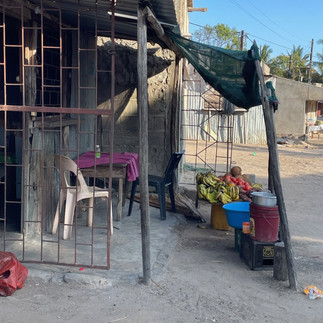


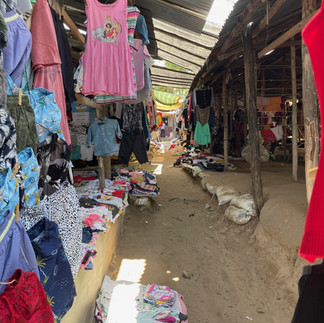


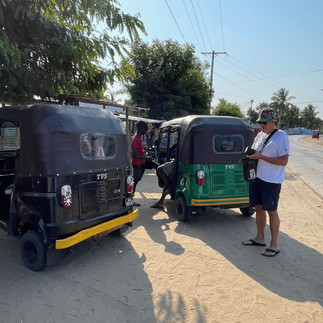


Tito's House
Two days later, we go shopping with Tito at Spar and the bakery. We fill our canisters with diesel for the Najuma and gasoline for the dinghy. We hit the road again in the pickup truck and then, with the help of Tito and Pieter, load everything into the dinghy. We buy some food for Tito and his family, and the little girl gets a new ball that she's been wanting for a long time.
The dinghy rides to the beach and back to the boat are always quite choppy due to the strong swells that push into the lagoon. We get shaken around and soaked. As in Bazaruto, we're the only boat anchored here. The wind, waves, and current make life on board choppy, and we bob violently. The tide is impressive.


Swinging on anchor; the red dots and lines show our ship's movements at anchor. The green area shows the shallows near the shore. During spring tide (full moon), the tide difference is almost 5 meters.

Far out in the distance lies Najuma


Large tidal fluctuations. Fishermen take advantage of the current.
There's a beautiful lodge on the beach, perched a little higher on the dune. From the top, you have a fantastic view of the lagoon. The owners allow us to use the pool, restaurant, and bar. This is very accommodating and kind. We're enjoying it to the fullest, as we'll ultimately have to wait three weeks until a good weather window finally appears, allowing us to sail on to Richards Bay in South Africa.


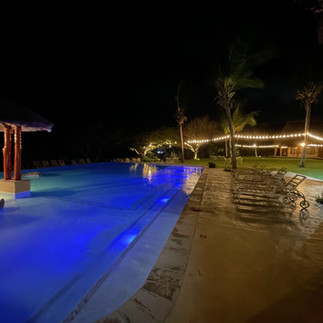
On the day we clear out, Tito helps us again, and at the end of the tour, we drive past his house again. The concrete floor is in place and drying, the bricks have been used to connect the walls to the floor, and the door with the lock is also installed. We're so happy about this; he can now move in with his wife and child in about a week.

Check out
The next morning we finally set off. We lifted anchor a few hours before high tide so that we could easily navigate the shallow areas at the exit of the lagoon, the so-called pass, into the Indian Ocean. As we left the protected waters of the lagoon and entered the pass it got pretty rough for the next 2-3 hours. Then we made it and we were well on our way to Richards Bay. We expected the passage to take about 4 days. Our friends from the Pazzo arrived at our anchorage near Bazaruto a few days ago and are now accompanying us to Richards Bay. According to the weather forecast it should be a relatively calm crossing. We'll see what else awaits us. South Africa, here we come.

on to new shores
Always a pleasure to read about your experiences and travel stories! Warm , Greetings from Vietnam! Gian & Susanna