Back to South Africa
- Sep 1, 2025
- 8 min read
Our passage to South Africa from 6 October to 6 November 2025
It's been some time since we arrived in South Africa, but we would still like to tell you about our passage from Mozambique to Knysna in South Africa.
Early in the morning, with first light and the rising tide, we leave our anchorage. The direct exit between Bazaruto and the offshore island, across all the shallows, is an adventure. We've gathered plenty of information from local deep-sea fishermen and are now hoping to be on the right track. We cautiously feel our way across the sandbanks and between the reefs. We want to be at the apex at high tide so we can navigate through the waves rolling in from the sea. High tide would be the time, at least that's what we were told. There are usually nuances, as we'll learn later. The Pazzo, acquaintances of ours, left their anchorage off Bazaruto heading north in the dark. They prefer the safe route around the top, which is understandable given their 2.50 m draft. We reach the bar at the exit in time, but the waves are still very high, and it takes some time before we reach open, deep water; once again, we're thoroughly shaken up.
The sun and the wind are with us. The sea is still rough, and we're sailing close-hauled south. Later, the wind should shift slightly to the east, giving us a beam reach. We've been given a good weather window, and according to our forecast, our route planning should bring us into Richards Bay (South Africa) in four days. For our trips, we use weather software with integrated route planning that provides us with detailed information about wind conditions and waves. Gottfried acts as weather forecaster during the passages. Every six hours, in rhythm with the changing of the watch, the latest data is imported, and adjustments to the route are made if necessary. Changing winds, currents, and waves constantly influence the sail plan. This means changing sails, reefing (reducing the sails), or, in calm conditions, even starting the engines. During the day, in good conditions, we always try to achieve the maximum. At night, we go into "sleep mode" with reduced sails, very conservatively and on the safe side. We are not in a hurry and always try to sail from one port to the next with the largest possible weather windows.
Off the island of Bazaruto, after passing through, we meet up with Pazzo. It's a wonderful sight: Pazzo under full sail, leaning into the wind, speeding ahead of us towards South Africa. We won't lose sight of each other for the next four days. There's always something calming about sailing a passage together. It gives a sense of togetherness and also security.
Minutes turn into hours, and hours into days. Sunrises and sunsets accompany us across the vast ocean. We listen to the waves and the wind. The daily routine on board has become familiar to us; much has become routine. We enjoy the quiet hours on the water. Passages aren't always so light-footed and undisturbed, but this time we are rewarded for all our hard work.

bye bye Bazaruto, bye bye Mozambique


On the morning of the fifth day, we reach Richards Bay, back in South Africa after more than a year. Somehow, everything feels familiar. Clearing customs runs smoothly. A big thank you to OSASA (Ocean Sailing Association of South Africa). For a small fee, they handled all the formalities for us in advance. Immigration, visas, etc., are handled directly in the port, and for customs clearance, we are taken by taxi to the authorities and back. The crew of the Pazzo, Cindy and Willi, chose the better course and arrived an hour before us. The joy of seeing each other again is immense; we all fall into each other's arms. In the afternoon, we retreat to the marina in Richards Bay and enjoy a lovely evening at the yacht club. As always, there is much to talk about and to process the experiences we experienced during the passage. Arriving is always a small, personal victory. We all found the courage to venture out into the Indian Ocean and expose ourselves to the long watches, the strong winds, and the waves. It always takes a little push to cast off and set sail; the uncertainty is always there. Many people ask themselves, why do it? It's a personal challenge, a great adventure, finding peace in the endless expanse, the feeling of achieving something together. There are many more explanations. Perhaps it can be summed up simply: it's simply fun and enjoyable. Besides, we're not daredevils; we try to reduce risk to an absolute minimum with careful planning and the know-how gained from many nautical miles. Sometimes we succeed very well, like on the last leg, but sometimes we're proven wrong.




Call at Richards Bay


Alkant beach


our days in Richards Bay
We're enjoying a few days in Richards Bay, but we're closely monitoring the weather. We want to sail south as quickly as possible, back to Knysna. That's still 700 nautical miles along the South African coast and the Agulhas Current. For many sailors, this is a difficult route, with few ports and very unstable weather, along with all the major capes. Nobody wants to get caught in a storm here off the coast of South Africa.





Richards Bay exit
After just under a week, a large weather window opens, and we plan to sail at least as far as East London, or even better, as far as Port Elizabeth. The start in these regions always occurs after a low-pressure system has passed through, meaning there's a lot of wind on our noses and a rough sea. The first few hours are somewhat strenuous. We cast off in the morning and set a course about 10 miles offshore to reach the Agulhas Current as quickly as possible. This current runs quite far from the coast all the way down to Margate. After that, it approaches within a mile of the coast. We're making good progress and should have a northeasterly wind by midnight, ideal for our journey south. We're anticipating two or even three nights at sea. My watch tonight is from 3:00 a.m. to 6:00 a.m. Even the skipper can't pick the best times; we always go through it one after the other. I'm somewhat surprised to see that we still have a headwind from the southwest. Actually, we were supposed to change to a broader wind. I check the usual weather portals and they all show the same thing: northeasterly winds. Forecasts aren't accurate to the hour either, as we've gained enough experience by now, but I'm still a bit worried. By six o'clock, we've long since passed Durban and are almost at Margate. From then on, the current is blowing at up to five knots. Wind against the current should be avoided at all costs when the wind speed is over Force 4. The waves and wind are still moderate, but that should change completely in the next half hour. Renier relieves me at six o'clock, and at 6:10 he calls me back to the cockpit. The wind has picked up and is getting stronger and stronger. In the end, we have over 40 knots of wind on our noses and the waves suddenly get higher and higher, washing over us at intervals all the way up to the helm and even higher beyond. Estimating wave heights is always difficult, so I don't want to give any details here. The sea begins to roar and it is truly frightening. Waves crest against us, and we decide the only right thing to do is turn around and head back to the safe harbor of Durban. With the headsail reefed and both engines at full throttle, we're stationary, not to mention the current pushing us forward. Turning around becomes an adventure; we don't want to be caught sideways by a wave; that would be fatal. Shortly before, a tanker that had been sailing alongside us for a long time turned at a right angle from the coast and headed out to sea at full speed.
Time for us to head back to Durban. The journey will take another 11 hours, and we arrive at the marina in Durban in the pouring rain. Helping hands are at the head dock, and we're tied up securely at the dock—not comfortable, but at least safe.
What did we overlook, what happened? An unforecasted Cut-Off Low (COL) caught us off guard. This is an isolated, pinched upper-level low that appears as a low-pressure vortex and is no longer connected to the main current. Along with the COL comes a lot of rain and a period of bad weather that can be very localized. In our case, even the coastal stations were caught off guard, making a forecast obsolete. In retrospect, our ambitions to sail directly to PE were somewhat exaggerated, and I could have turned towards Durban earlier. With every nautical mile, you learn something new and gain experience. We are all very happy that it turned out well.
Now we're stuck in Durban. It's October 21st, and our journey south seems to be never-ending. We're making the best of it. First, the boat is cleaned and everything is put back in order. Afterward, there's time for shopping, walks on the beach, restaurant visits, and a bit of harbor gossip with our shipmates.


Calling in Durban; it is wet and cold


Durban Harbour and Marina





our time in Durban
On November 1st, we set sail for Port Elizabeth. The weather is perfect for our planned leg along the Wild Coast. The coast shows itself at its best, and we enjoy the ride across the flat waters, unfortunately with little wind, but with plenty of sunshine. All in all, a very relaxing trip.
On November 2nd, we arrive in PE and get a nice spot at the floating dock. We'll wait here for a few days and wait for a small low-pressure system to pass by. Here, we meet Marcel and his crew. They're ferrying an Outremer Cat from Malaysia to Cape Town. Marcel is a friend of Mark and Liz—what a coincidence! We'll all celebrate later with a long braai in Knysna. Also worth mentioning is the lovely restaurant right by the marina. PE is the port of the chokka boats (squid fishing boats), so you can find all sorts of squid on your plate; very tasty! The town also offers a promenade, a shopping center with ocean views, and several beaches.


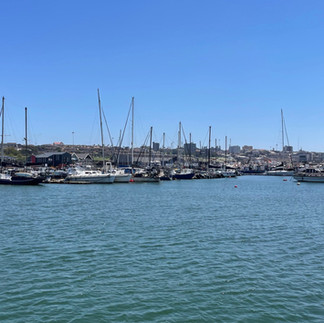


Marina Port Elizabeth
On November 5th, we set off again. First, against the wind and waves, as usual, then a brisk course for Knysna. Early in the morning on November 6th, we reached the Knysna Heads in perfect weather and just in time to enter the lagoon with high tide. This time, the Heads showed their best side, and we managed to sail through without any problems. It's an indescribable feeling to be "home" again, where it all began with our Najuma. We were already expected and warmly greeted and welcomed. For us, a long journey with many impressions has come to an end. We will be moving in with Liz and Mark in the next few days and then soon travel to Europe to celebrate Christmas with our children.
First, we have to clear out the Najuma, as we have a number of major and minor warranty jobs pending. We don't yet know how long these will take, but for now, after an exciting time and a long cruise, we're treating ourselves to some rest.

Knysna Lagoon
Comments